Missing Cases in China’s Courts
Beginning in 2014, the Supreme People's Court required courts across the country to upload their judicial decisions to a centralized website, China Judgments Online (CJO). The result was a research treasure trove of more than 166 million judgments (as of July 2026). It is one of the largest collections of public court records in the world, and an unprecedented window into how Chinese courts handle cases from divorce and custody to corruption and protest.
Yet this window into China’s legal system has never been completely open, and it is now closing in places. Courts vary enormously in how many cases they actually upload, and since 2021 some categories of cases have disappeared from the site entirely. The hard problem for researchers is that court-level case totals are not published in any systematic or readily accessible form, so it has been nearly impossible to know what is missing, and where[1].
The China Court Case Availability Portal (https://chinadatalab.ucsd.edu/chinese-court-case-availability/) helps address this problem. Developed by researchers at Columbia University, UC Berkeley, and UC San Diego, the portal provides court-level estimates of judicial transparency across China from 2013 to 2022[2]. Users can explore and download data by court, province, year, and case type. This portal makes it possible to identify where court records are available, and where significant gaps are.
Figure 1. Court Caseloads and Publicly Available Judgments, 2010–2024
Figure 1 illustrates the gap between total caseloads and publicly available judgments from 2010 to 2024[3]. The space between the two lines is the missing public record: cases that were concluded but whose judgments never appeared online. The availability gap has always existed. It narrowed from 2014 to 2020 as uploads climbed, then widened sharply after 2021 as uploads fell while caseloads kept rising. Nationally, we can see this gap directly. This data portal helps estimate the public availability of cases at both the court and case-type levels.
Data
The portal draws on the Columbia–UC San Diego Judicial Decision Database, which contains more than 140 million judgments published on China Judgments Online between 2013 and 2022. The database was assembled in two waves of collection: the first captured roughly 44 million judgments uploaded between 2013 and mid-2018, and the second a further 96 million uploaded between mid-2018 and 2022. In the second wave, some collected judgments include only partial case information rather than the full text of the decision. The portal counts a case as available whenever any such record exists, so availability here means a judgment was disclosed in some form, not necessarily that its full text can be read. Full-text availability on the site today is itself difficult to determine, since the platform continually adds and removes cases. For more on how we handle this, see our paper, Addressing Missingness in Serialized Bureaucratic Data: The Case of Chinese Courts.[4]
These judgments come from 3,638 courts across China, including 3,204 basic, 402 intermediate, and 31 high courts, and the Supreme People’s Court. Before analysis, the data were carefully cleaned to remove duplicate records and organize cases by type, including civil, criminal, and administrative litigation.
How Do We Estimate Missing Cases?
Each year, administrative, civil, and criminal litigation cases are serially numbered by the order in which they were assigned to each subdivision of the court. Subdivisions (sometimes also referred to as “tribunals” in English language scholarship on Chinese courts) are sections of the court that deal with a particular case type, for example, criminal first-instance (刑初).
This numbering system allows us to estimate how many total cases a court has handled, even when only a portion of those cases are publicly available.
Our approach builds on a well-known statistical technique known as the German Tank Problem[4]. During World War II, statisticians used serial numbers from captured German tanks to estimate how many tanks Germany had actually produced. We apply the same logic to Chinese court case numbers: because Chinese courts assign case numbers sequentially, the judgments that remain publicly accessible allow us to estimate the total number of cases heard by each court subdivision, including those that were never disclosed online.
By examining the range and distribution of published case numbers, we can estimate the total number of cases heard by a court and calculate what share of those cases are publicly available using the minimum variance unbiased estimator (MVUE) solution.
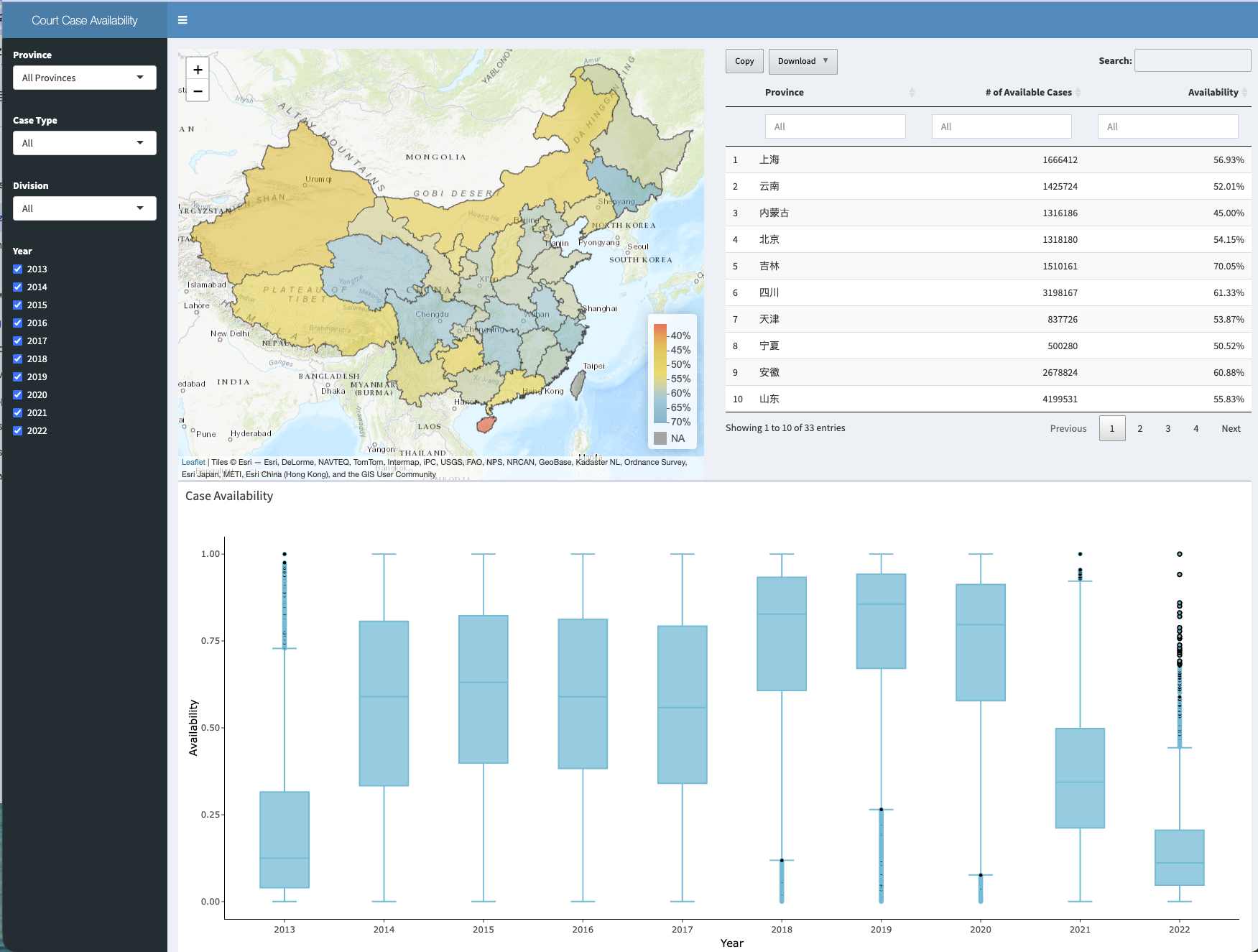
China doesn't publish case totals at the individual-court level systematically, so there's little ground-truth data to validate our estimates against. To work around this, we built a validation set by hand, combining work reports from a random sample of 300 courts with internal statistics from Henan province. This gave us 110 data points to test against. The results show a high degree of reliability, with median estimation errors of only 4.1% for criminal cases and 9.5% for civil and administrative cases. As shown in Figure 2, we present these estimated availability rates in the China Court Case Availability Portal.
Figure 2. China Court Case Availability Portal
What Have We Learned?
1. Transparency Varies Across Case Types
Not all court cases are equally likely to be published.
As shown in Figure 3, and taking the data from 2013 to 2018 as an example, criminal cases are the most transparent, with courts publishing roughly 68% of their estimated caseloads. Administrative cases, which often involve disputes between citizens and government agencies, are less transparent at about 57%. Civil cases are the least transparent, with only about 40% of estimated cases appearing in public records.
Figure 3. Availability by Case Type
Part of this difference reflects privacy concerns, particularly in family and mediation-related disputes. However, political sensitivity may also play a role, especially in administrative litigation.
2. Transparency Differs Across Regions
Judicial transparency is not evenly distributed across China.
Figure 4. Map of China Showing the Aggregate Level of Transparency Across the Years
Courts in many coastal provinces tend to publish a larger share of their judgments than courts in western regions. As shown in Figure 3, in places such as Xinjiang and Tibet, public access to court decisions is often significantly lower, resulting in a much thinner public record.
These regional differences suggest that transparency is shaped not only by national policies but also by local political and institutional factors.
3. Transparency Has Declined Since 2021
Consistent with what many researchers have noted, judicial transparency in China is moving in the opposite direction from what was widely expected a decade ago. As shown in Figure 5, beginning in 2021, the share of cases with publicly available judgments declined substantially.
In earlier research published in the Columbia Law Review, we documented that more than 600,000 criminal judgments disappeared from China Judgments Online between 2020 and 2021[5]. While some categories of politically sensitive cases became harder to access, the deletions appeared to be somewhat ad hoc rather than systematically driven by political concerns.
In late 2023, the Court announced two new databases: the National Court Judgment Documents Database (全国法院裁判文书库), accessible only to internal court personnel, and the People's Courts Case Database (人民法院案例库), a public collection of a much smaller set of edited "reference" and "guiding" cases meant to guide court adjudication. When the internal database was first announced, many observers feared it would effectively replace China Judgments Online and hollow out public access. So far, CJO remains in operation, and uploads have partly recovered since 2024. But it remains unclear whether this recovery is evenly distributed across regions and case types. Looking ahead, we hope to extend this portal to more recent years and provide insights on this question.
Figure 5. Case Availability Over Time
In short, the window into China’s judicial system was never fully open—and in recent years, it has become narrower still.
Looking Ahead
The portal currently covers the years 2013-2022. We plan to add 2023-2025 years in a future update.
As new data become available, the portal will allow researchers to track changes in judicial transparency and better understand how access to court information is evolving in China.
We welcome feedback and look forward to seeing how others use these data in their own research.
Authors
Xiaohan Wu, Political Science Ph.D., UC San Diego
Young Yang, Research Data Analyst, China Data Lab at the 21st Century China Center, UC San Diego School of Global Policy and Strategy.
Project Team Members
Benjamin Liebman, Robert L. Lieff Professor of Law, Columbia Law School
Rachel Stern, Professor of Law and Political Science, UC Berkeley
Margaret Roberts, Professor of Political Science, UC San Diego
Xiaohan Wu, Political Science Ph.D., UC San Diego
Luke Sanford, Assistant Professor of Environmental Policy and Governance; Assistant Professor of Political Science, Yale University
References and Notes
- This information is not entirely absent from the public record. Individual courts' annual work reports sometimes include their case totals, and higher-level courts consolidate figures from the courts beneath them. But recovering court-by-court totals this way is a substantial undertaking: coverage is uneven across courts and years, and it requires compiling reports from thousands of courts nationwide.
- China already has a well-known judicial transparency measure: the Chinese Academy of Social Sciences (CASS) judicial transparency rating. But it answers a different question than ours. The CASS index is far broader in what it measures, covering five dimensions of transparency: judicial-administration information (审务信息公开), adjudication information (审判信息公开), enforcement information (执行信息公开), judicial data (司法数据公开), and judicial-reform information (司法改革信息公开). Our portal focuses on just one of these, judicial data, but measures it far more comprehensively. Whereas CASS rates only high courts and a small sample of intermediate courts (fewer than 100 courts per year), our portal covers the basic courts that hear the vast majority of cases in China. In short, CASS offers a wide but shallow view across court types, while our portal offers a deep, court-by-court measure of case availability. Even so, some findings line up. For example, the CASS rating ranks Jilin(吉林) as most transparent in 2016, and our portal shows the same.
- Official judicial statistics reports : 2013 全国法院司法统计公报 ; 2014 全国法院司法统计公报 ; 2015 全国法院司法统计公报 ; 2016 全国法院司法统计公报 ; 2017 全国法院司法统计公报 ; 2018 全国法院司法统计公报 ; 2019 全国法院司法统计公报 ; 2020 全国法院司法统计公报 ; 2021 全国法院司法统计公报 ; 2022 全国法院司法统计公报 ; 2023 全国法院司法统计公报 ; 2024 全国法院司法统计公报 .
- Wu, X., Roberts, M. E., Stern, R. E., Liebman, B. L., Gupta, A., & Sanford, L. (2025). Addressing Missingness in Serialized Bureaucratic Data: The Case of Chinese Courts. Sociological Methods & Research, 00491241251340610.
- Liebman, B. L., Stern, R. E., Wu, X., & Roberts, M. E. (2023). Rolling back transparency in China's courts. Columbia Law Review, 123(8), 2024-3.